

Post-operative recovery · Johannesburg
Recovery is not an afterthought. It is the outcome.
Private, supervised recovery after elective surgery — run to your surgeon’s protocol, in a place designed for healing rather than for entertaining.
OBSERVED
Charted observations, not eyeballed
SURGEON-LED
Your protocol, not a standard one
MOBILISED EARLY
Because immobility is what causes clots
PRIVATE
Discreet arrivals, private accommodation
Theatre is a few hours. Healing is the next three weeks.
Most people plan the operation in detail and improvise the recovery. They go home to a house with stairs, a family that needs feeding, a phone that does not stop, and a fridge with nothing in it that supports tissue repair. Then they sit still for a week, which is exactly the wrong thing to do.
The Surgical Recovery Programme exists for the period after the procedure. Observations recorded properly. Wounds cared for to your surgeon’s protocol. Early graded mobilisation, because movement is what prevents clots. Nutrition built for healing rather than for weight. And an environment with no alcohol, no nicotine, no lifting and no broken sleep.
None of that is glamorous. All of it is what actually determines how well you heal.
What this is, and what it is not.
We would rather be plain about this before you book than reassuring about it afterwards.
A supervised recovery environment
Clinical oversight by registered nursing staff with physician review, wound and drain care to your surgeon’s protocol, recorded observations, prescribed medication administered on schedule, early mobilisation, lymphatic drainage and nutrition built for healing — delivered privately, in a five-star setting, for as long as your surgeon recommends.
A hospital
Vivari is not a surgical or acute care facility and does not manage surgical complications. Where one develops or is suspected, our protocol is to contact your surgeon immediately and transfer you to an appropriate acute facility. Your surgeon remains responsible for your surgical outcome throughout, and we work to their instructions rather than to our own.
What the days actually involve.
Your programme is written from your surgeon’s post-operative instructions and your operative note, then adjusted daily against how you are actually healing.
- Clinical observation
- Regular recorded observations — temperature, pulse, blood pressure, respiratory rate and pain score — charted rather than eyeballed. The point of observation is to notice a change early, and a change is only visible against a baseline that was written down.
- Wound and drain care
- Dressing changes, wound inspection and drain management performed to the protocol your surgeon specifies, at the intervals they specify. Photographic documentation where your surgeon requests it, shared with them and with nobody else.
- Venous thromboembolism prevention
- Early graded mobilisation from the first day, compression as prescribed, hydration monitoring and any anticoagulation your surgeon has ordered. Clot prevention after surgery is unglamorous and it is the single most important thing a recovery environment does.
- Medication and pain management
- Your prescribed regimen administered and recorded on schedule, with pain scored regularly rather than asked about in passing. Uncontrolled pain suppresses mobility, and immobility is what causes the complications.
- Nutrition for healing
- Protein requirements after surgery rise substantially, and this is the worst possible moment to eat less. Meals are prepared by our kitchen team for tissue repair rather than for weight — adequate protein, micronutrients relevant to wound healing, and enough energy to heal on. Where your surgeon has specified dietary restrictions, we work to them.
- Lymphatic drainage
- Daily manual lymphatic drainage by a trained therapist, working to the technique and timing appropriate to your procedure and started only once your surgeon has cleared it.
- Hyperbaric oxygen therapy
- Available daily and delivered where your treating surgeon considers it appropriate for your case. It increases dissolved oxygen availability in plasma and tissue. It is not offered here as a treatment for any complication, and it is not a substitute for surgical review.
- A controlled environment
- No alcohol, no nicotine, no interrupted sleep, no lifting, no children needing collecting from school. Nicotine is the single most damaging modifiable factor in wound healing, and a supervised environment where it is simply unavailable does more for a surgical result than most therapies do.
Hydrotherapy, sauna, steam and swimming are not part of this programme. Immersion, heat and humidity are avoided while wounds are healing, and any relaxation treatment is selected to avoid the operative area entirely. Our other programmes include those facilities; this one deliberately does not.
Who it is for.
Adults recovering from elective surgery who would otherwise be recovering unsupervised at home, and who want the recovery to be run properly.
- Facial surgery — where swelling management and positioning matter and the visible result is the point
- Breast and body surgery — where drains, compression and restricted movement make home difficult
- Larger or combined procedures — where the recovery is genuinely demanding and being alone is a risk
- Guests travelling from outside Gauteng or from abroad, who cannot go home immediately
- Anyone for whom privacy during recovery is a requirement rather than a preference
Admission is by assessment. It requires your surgeon’s written agreement, your operative note and their post-operative instructions, and a pre-admission review establishing that supervised recovery outside a hospital is appropriate for your procedure and your health. Some procedures and some patients need an acute facility instead, and where that is the case we will say so.
Your protocol, followed exactly.
We take referrals from surgeons across Gauteng and further afield, and we understand that you are handing over a patient whose outcome remains your responsibility.
You receive a written admission agreement setting out precisely what we will and will not do, and direct access to the clinical team for the duration of the stay. If anything concerns us — an observation outside range, a wound that does not look right, a patient who is not progressing — you are contacted immediately and the patient is transferred where that is the safer course. We do not adjust your instructions, we do not add therapies you have not sanctioned, and we do not offer clinical opinions on your surgical result to your patient.
We do not issue routine written reports or discharge summaries. Your patient’s follow-up remains between the two of you, and we do not place ourselves in the middle of it.
What is included.
Clinical
- Pre-admission assessment and surgeon liaison
- Clinical oversight by registered nursing staff
- Physician review during your stay
- Recorded observations and pain scoring
- Wound and drain care to your surgeon’s protocol
- Prescribed medication administered and recorded
- Early graded mobilisation and compression as prescribed
- Immediate surgeon notification if anything concerns us
- Documented transfer protocol
Recovery
- Private luxury accommodation
- All meals and soft beverages, built for tissue repair
- Daily manual lymphatic drainage, once cleared
- Hyperbaric oxygen therapy where your surgeon considers it appropriate
- Infrared facility access where appropriate to your procedure
- Relaxation treatments avoiding the operative area
- Alcohol-free and nicotine-free environment
- Return transfers from OR Tambo or Lanseria
What supervised recovery can, and cannot, do.
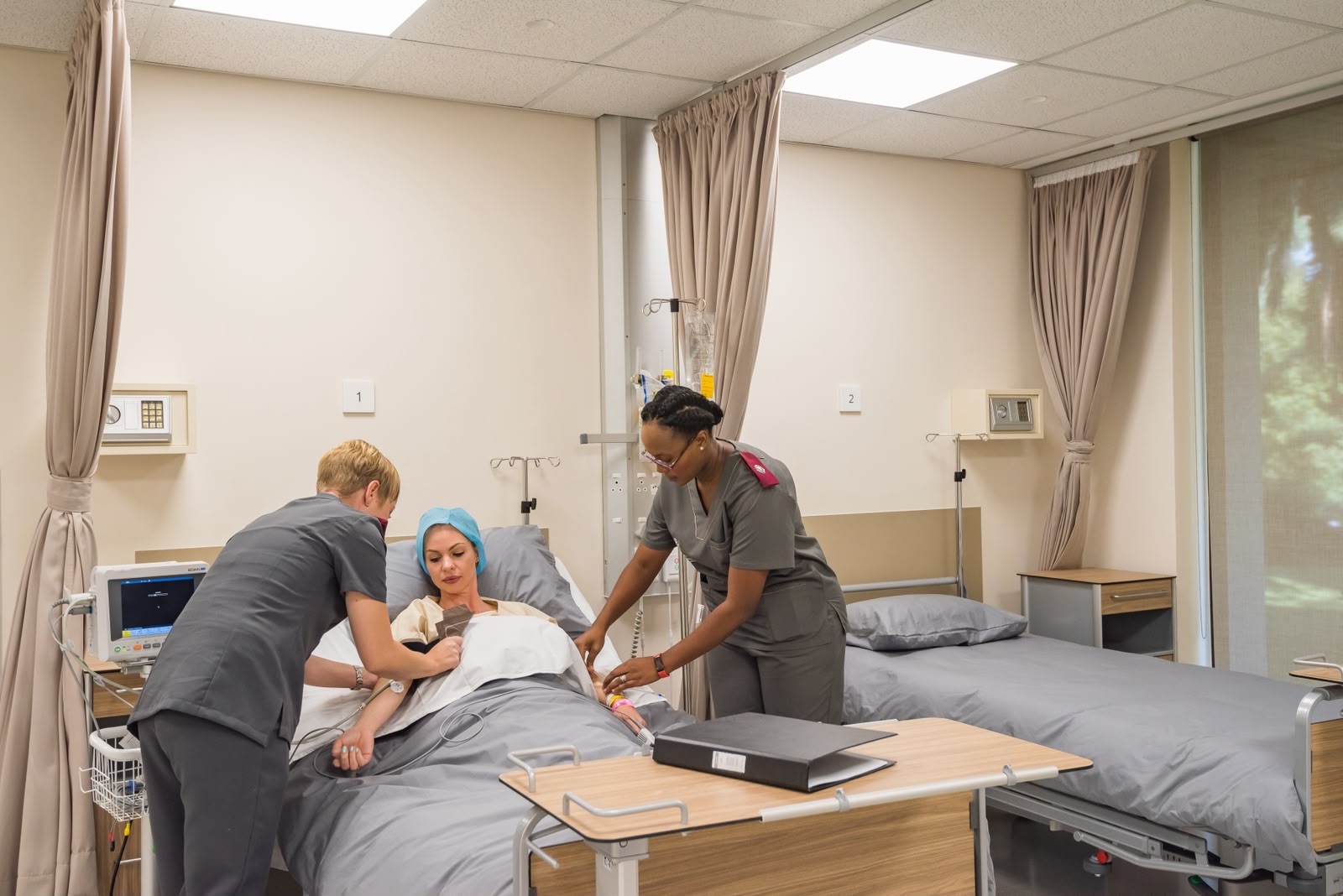
A well-run recovery gives you the conditions healing needs: rest that is genuinely uninterrupted, adequate protein, controlled pain, early movement, wounds attended to properly, and no alcohol or nicotine anywhere near you.
It cannot guarantee a result, prevent every complication, or change what happened in theatre. Healing varies with the procedure, your health, your age and factors nobody controls. What supervision does is notice a problem early and act on it, which is a different claim and a more honest one.
Recovery timelines vary considerably by procedure. Your surgeon sets them, and we work to what they tell us.
Everything above is included.
Private accommodation, all meals and soft beverages, clinical oversight and observations, wound and drain care, medication administration, daily lymphatic drainage, hyperbaric oxygen therapy where sanctioned by your surgeon, surgeon liaison at admission, and airport transfers.
Minimum stay is set at pre-admission according to your procedure. Any additional investigation, medication or intervention required during your stay is quoted separately.
Bookings are confirmed only once your surgeon’s written agreement, operative note and post-operative instructions have been received, and once pre-admission assessment has established that supervised recovery outside a hospital is appropriate for you. Consultations are held in confidence.
Before you enquire.
Is Vivari a hospital?
No, and this matters. Vivari is a supervised recovery environment, not a surgical or acute care facility. We provide clinical oversight, wound care, observation and therapies during the recovery period. Where a complication develops or is suspected, our protocol is to contact your surgeon immediately and transfer you to an appropriate acute facility – not to manage it here. Your surgeon remains responsible for your surgical outcome throughout.
Can I come if my surgery was done elsewhere?
Yes. A significant proportion of guests are recovering from procedures performed by their own surgeons. Admission is by assessment and requires your surgeon’s written agreement, a copy of your operative note and their post-operative instructions. We work to their protocol, not to a standard one.
When can I use the pool, sauna or spa?
Not while wounds are healing. Immersion in water, heat and steam are all avoided until your surgeon confirms your incisions are sealed, which for most procedures is at least two weeks. This programme deliberately does not include the hydrotherapy and sauna access that our other programmes do, and any relaxation treatment is selected to avoid the operative area entirely.
What about exercise?
Graded mobilisation from day one, because movement prevents clots and immobility causes them. That means supervised walking and gentle range-of-movement work, progressed only as your surgeon permits. It does not mean training sessions, Pilates or anything resembling a fitness programme, and any page that offers you those after surgery has not thought about it.
Do you provide IV nutrient therapy?
Only where clinically indicated and prescribed – for example where oral intake is inadequate. Intravenous access carries its own infection risk, which is not a sensible trade in a post-operative patient who is eating normally, and there is no good evidence that routine IV vitamins improve surgical healing.
How long should I stay?
It depends entirely on the procedure. Facial surgery is commonly five to seven nights; larger body procedures often longer. Your surgeon’s recommendation determines it, and we will tell you honestly if we think the stay you have booked is too short.
Will you report back to my surgeon?
Not routinely. We do not issue written progress reports or discharge summaries, and your follow-up stays between you and your surgeon. What we do without exception is contact them immediately if anything concerns us – an observation outside range, a wound that does not look right, a patient who is not progressing as expected – and transfer you to an acute facility where that is the safer course. That is a safety duty rather than a reporting service, and it is not optional.
How private is it?
Completely. Guests are accommodated privately, arrivals and departures are managed discreetly, and no clinical information is shared with anyone other than your treating surgeon without your written consent. Discretion is a condition of the service rather than an extra.